
The Case for AI in Therapy’s Back Office
How AI could augment the work of therapists: improving the invisible infrastructure that keeps them running behind the scenes.


Therapy sessions are exhausting! I do this every week. Spend 45 to 50 minutes dumping my difficult thoughts, yell (or cry a bit), then collapse on a couch and digest for a while. Meanwhile, my therapist sprints between sessions, where he has to eat a banana, pee, and chart key insights and “aha!” lightbulb moments in 10 minutes. Rinse and repeat.
Public conversation about AI and mental health is laser-focused on general-purpose chatbots offering mental health care and services. This is a different landscape from the scenario I just described with my therapist, and one where AI intervenes differently.
Let’s be clear…general-purpose AI can’t be a good or safe therapist right now. This is a hill I will die on in summer 2026. See my prior post on this here:

But what about the stones unturned for how AI can benefit mental health care and therapy?
I’m a cautious optimist about technology and AI. So today, I want to talk about opportunities for AI to improve the work of therapists. In a recent expert panel I did with Headspace, we all discussed the potential of AI, and I’ve been reflecting on it and my colleagues’ responses over the last few weeks. (in case you want to watch the conversation, here’s the link.)
Opportunity lies beyond consumer chatbots and their unhinged rants; AI could be an integral part of the invisible infrastructure that keeps real therapy sessions running behind the scenes. While I’m collapsing on the couch from mental fatigue, my therapist has assistance in running their caseload better. Not to make it easier to see patients back-to-back and ring therapists1 dry for their emotional connection. But to improve their practice and care.
And of course, dear reader, you know I’m going to give you the research-baked takes (starting with this summary) about what AI can do. Each of these ideas is grounded in statistics, innovations, and opportunities that the science points to.
Let’s get into it.
Death By Documentation
I’ve already set the stage for a typical encounter, but let’s not forget about the business of running a practice. Many therapists run their own private practices, meaning they run small businesses. Most sessions are 45 or 50 minutes. This leaves therapists with a precious 10 to 15 minutes to take care of themselves between clients. Caseloads for therapists range from 15 to 25 client hours per week, with some seeing as many as 30. The number of people they have at a time can be higher (because some people don’t come every week).
Let’s just knock out a low-hanging fruit - administrative tasks. Admin is one of the least favorite parts of the job (just let me get back to doing research, not filling out expense reports!). AI can help with many administrative tasks. Billing and invoicing, scheduling and rescheduling, and filing insurance claims.
Some of these may be best done by little programs that don’t use AI - for example, we’ve had scheduling systems like Calendly for years, and I’m sure rescheduling doesn’t need to be handled by AI. However, when integrated with an agent that can oversee, some of the magic of AI could happen, reducing workloads and coordinating tasks across multiple actions.
But the biggest research-backed win is in another area of “paperwork”. During those breaks, therapists also try to document their sessions, chart progress, and decide on next steps. Note-taking and documentation are tough in healthcare. Therapists spend about 10-15 minutes per encounter writing notes and documenting what happened in therapy (the OG stats source).
Note-taking, summarization, and documentation are some of the biggest gains from AI for therapy that folks are talking about—I hear about it all the time. Here, the AI agent acts as a scaffold for notetaking, reflecting on past notes, and encouraging people to think through their treatment plans. A less intense version of this is verbal note-taking and dictation software, which lets folks talk through their experiences during a session. These technologies are already shipping and being built into EHR systems to listen to patient conversations and record key takeaways. In addition to summarizing or capturing notes, a cool opportunity for therapists is to serve as a reflective partner based on their other notes and processes. That’s supported by the research here.
Supporting activities like note-taking and summarization – with oversight and data protection – could make this much better. What if toolkits offered good summarization that helps therapists maintain the skill of notetaking rather than degrading it? Checking against specific protocols or approaches?
I don’t want to overhype the potential here, but documentation burden is a major issue for providers (not just therapists) and a reason for burnout. Saving hours a day on this work could help support therapists better and let them get home faster.
Therapy Homework that Actually Gets Done
Let’s talk about another area of assistance - therapeutic homework. Therapeutic homework is, as the name suggests, activities or thought prompts that a client takes home to practice. Not all therapists do homework, but it is more common in areas where skills are essential, like Cognitive Behavioral Therapy (CBT), Dialectical Behavior Therapy (DBT), and Motivational Interviewing (MI).
Practicing therapy skills in your everyday life is key to having them work. Sure, working through things in session helps. But those same skills are useful in navigating work and personal situations. If a therapist uses homework, it’s an effective intervention. There have been a ton of meta-reviews on this, showing that the more homework a client does from therapy, the better the outcomes for CBT (the metareview; and individual study). Even doing some homework helps the CBT processes for depression and anxiety.
(Confused about what a meta review is and why I’m excited about them? Take a look at this post, which explains the hierarchy of empirical scientific knowledge.)

Therapy homework comes in many formats. These can be mood or other trackers (like substance use), thought prompts throughout the day, or worksheets to practice a skill. (My therapist loves to assign me ~books~ because I’m a nerd and I’ll read them. I then give him book recommendations back. It’s great.) Here’s an example from CBT:
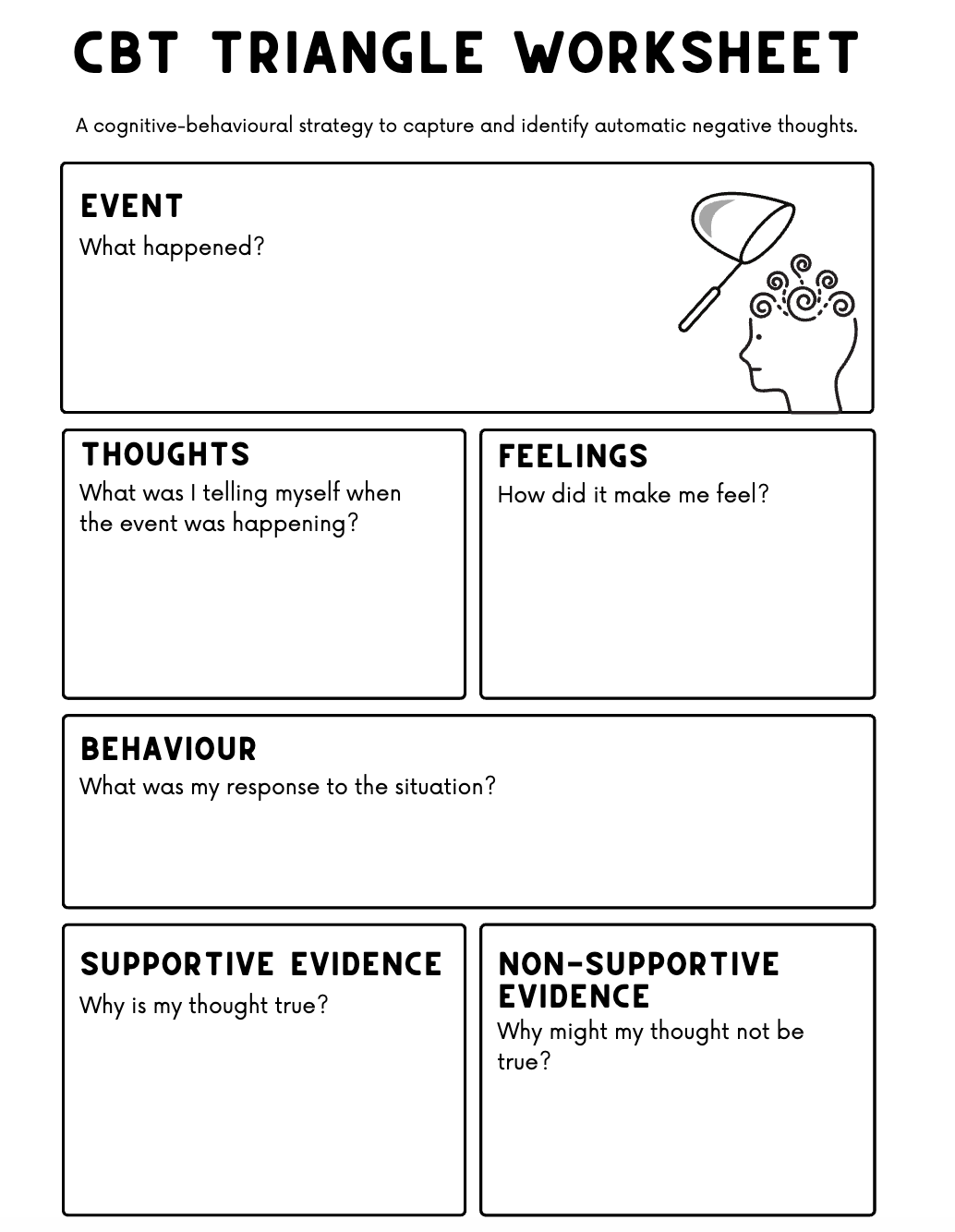
Example from: https://www.universalcoachinstitute.com/cbt-triangle/
AI could take these worksheets and homework examples and serve as an interactive partner. Here, the AI provides a safe conversation space for supervised dialogue and live worksheets. Taking CBT or DBT worksheets in a guarded environment so they get completed and shown back to the therapist next week.
This is already in development. A hot-off-the-press study from my main conference studied this. They built an AI tool for tracking, delivering, and managing therapy homework sessions. The bot helped manage the homework and lightly summarized the findings for the therapist. In a small pilot study with 14 therapists, they found it helped their cognitive load and management. Sweet.
This is different than an off-the-shelf bot that doesn’t know how to help — these systems need therapists-in-the-loop and guardrails galore. This is a purpose-built bot that guides through scaffolded plans, with therapists able to oversee the conversations. Time limits on use. Because therapy homework is a lot lower stakes than crisis conversations and can tolerate some errors, this is something we can build. Because the therapist oversees it, they can have discretion over when an AI agent is appropriate for a patient and when it is not.
Practice Before Real Patients
Another area of interest is training. It’s difficult to get hands-on experience with patients, and we often do so through long, supervised clinical rotations. At that point, the therapist has finished their training, and we just let them out on clients. The options during training are therapists practicing with actors or with each other. Not bad, necessarily, but it can be tough for authenticity.
We’ve researched this problem. We worked with novice support givers in a mental health crisis community to design how they wanted AI systems to train them through tough situations. Many of those people were nervous about what to do and needed help walking through those scenarios.
So we built and tested personas that helped people practice the skills they needed to give successful advice in tough moments. These work by creating grounded personas, roles, or characters using AI systems to enable better practice. Other work focuses on this entirely - building awesome personas. And these personas can get deep.
We found that these novice support givers were aware of how realistic the chatbots sounded. However, they appreciated that they could practice on something before they had to help a human out.
To be clear: personas aren’t people. They’re not a replacement for talking to people in the practice or clinical training. Rather than just acting or watching others, this is another skill in people’s toolkit for naturalistic interactions.
Other research is developing similar “virtual patients” for aspiring doctors, medical students, and trainees to practice with. Working with 94 novice counselors, this group found that this practice LLM could help them “upskill” their own practices better than feedback alone.
Beyond novice therapists or counselors, could we use LLMs to expose people to new kinds of training they want to learn or practice? Or get feedback on their skills in sessions already? For example, these bots could help counselors sharpen micro-skills, like reflecting a client’s experiences to them more effectively.
Four Things That Still Keep Me Up At Night
Imagine we close our eyes, and AI leaps forward 100 years. Many of the technical issues of technology get solved: sycophancy, drift, and hallucinations. Even then, we’ll have to consider the downsides of great systems. Here are 4 worth considering now.
Privacy, Data Rights, Surveillance: No matter how AI is used here, data rights and personal privacy are key concerns. Who owns the data for therapy notes? Therapists’ notes are not subject to legal scrutiny and are considered private. Are systems designed to guarantee privacy, too? Can patients refuse if a provider wants to use an AI-powered EHR? AI can’t touch sensitive data like in-session recordings if it can’t guarantee the same standards of care, full stop.
Productivity and Workplace Performance: I warned about this earlier, but the goal of augmentation is NOT to increase therapists’ workload. It’s a problem if all the work gets outsourced to AI and, all of a sudden, therapists are working longer hours to correct it, see more patients, and wring them out like a rag, trying to extract every drop of emotional bandwidth and support. That’s cognitively demanding and not fair.
Balancing Patient Consent and the Therapeutic Alliance: The therapeutic alliance is the relationship between patient and therapist that makes the whole system work. How do therapists navigate AI and communicate benefits and tradeoffs to patients? How do builders make a recording not feel creepy and build trust? Therapists will have to develop new ways to communicate about tech use and its tradeoffs, and build transparency to make this work.
Deskilling: An important part of the process is allowing AI to handle some parts of the job while humans handle others. Deskilling (or losing skills) is a risk with new systems. What parts of care should we deskill? Could AI de-skill people from writing therapy notes? One solution: make these systems improve note-taking through reflection or critical appraisal rather than with an overreliant persona.
I don’t have the answers to these questions. Honestly, confronting them is the cost of building awesome new technology. And considering them in advance may mean we can develop our new AI to incorporate these ideas.
Augment, Don’t Replace
Public criticism of AI is warranted and justified for many AI uses. And our conversations about this often fixate on the places that AI is most likely to harm, like making shrimp Jesus and leading people down delusional spirals. I agree with this critique.
However, part of a rich tech practice is keeping an eye out for opportunities to improve in specific ways, and being mindful of the tradeoffs. A list of risks doesn’t mean we have to step away entirely. Sometimes, being a cautious optimist means approaching these difficult truths, doing more work to learn about the legitimate problems, and building to see what can be fixed. My goal is to augment the care infrastructure needed to provide and receive better mental health care. The benefits I listed here are augmentations, not replacements for other people or a way to glaze over the hazards.
In this piece, I’m going to loosely group these providers under the banner “therapist”. There are bunch of specialties that provide therapy to people.